

Generic drug business
- Director, Senior Managing Executive Officer
Sawai Group Holdings Co., Ltd.
Representative Director and President
Sawai Pharmaceutical Co., Ltd. - Toshiomi Nakate
With a strong awareness of and responsibility for our role in pharmaceuticals, we aim to remain the company of choice for society.
SWOT analysis
- Strengths
-
- Brand strength as top manufacturer
- Stable financial base
- Strengthened production capacity following quick investments
- Development capabilities that enable us to launch products first
- Formulation technologies that enable high-value-added products
- Weakness
-
- Securing and developing talent that can handle growing production capacity
- Constraints on productivity due to high-mix, low-volume production
- Opportunities
-
- Momentum toward restructuring of the generic drug industry
- Growing demand driven by population aging
- Growing healthcare and medical needs
- Generic drugs as social infrastructure
- Generic Drug Provider Evaluation System that promotes sales at reasonable prices
- Revision of the NHI drug pricing system for authorized generics (AGs)
- Threats
-
- Rising geopolitical risks
- Lower reliability due to generic drug supply instability
- Growing raw material and utility costs
- Lower NHI drug prices due to annual drug price revisions
- Changes in various systems
We deliver medicines with awareness and responsibility, always mindful of the people whose lives our work touches
I am Toshiomi Nakate, and I became Representative Director and President of Sawai Pharmaceutical Co., Ltd. in April 2026. My involvement in pharmaceutical sciences and the pharmaceutical industry began in 1985, when I joined Fujisawa Pharmaceutical Co., Ltd. (currently Astellas Pharma Inc.) after graduating from university. I spent more than 20 years there in formulation development, including formulation design and development at the company’s formulation research laboratories and technology transfer to factories. I subsequently served as plant manager at three plants and spent three years as representative director of a manufacturing subsidiary. Since joining Sawai Pharmaceutical, I have drawn on these experiences in overseeing quality assurance and reliability assurance.
I chose to pursue a career in the pharmaceutical industry because of my own experience with childhood asthma. When I was in elementary school, an inhaler that opened the airways became available; it was amazingly effective and I was deeply grateful for it. This experience not only prompted my choice of major at university but also became the starting point for my approach to corporate management. In my previous career, I was posted overseas in Germany, the United States, and Ireland. The insights I gained there into global pharmaceutical industry trends, from development and production to technology transfer, have also been invaluable assets in my role as a business leader.
As Senior Vice President of the Reliability Assurance Division, I was personally responsible for executing the initiatives undertaken under my predecessor to strengthen the foundations of quality and reliability assurance. Now, as President, my principal mission is to further embed the systems introduced to date in our workplaces and make them an integral part of Sawai’s culture. We aim to establish annual production capacity of 22 billion tablets at our own factories in fiscal 2026 and are moving forward with plans to expand this to 25 billion tablets by fiscal 2030. I will also take responsibility for steadily implementing the capacity enhancements at the Daini Kyushu Factory and Trust Pharmatech approved under my predecessor, further strengthening our supply capabilities.
Alongside expanding production capacity, it is important to develop the talent who support actual production and establish a system capable of producing medicines of reliable quality. The most important aspect of our quality initiatives is for every employee to recognize and take responsibility for the fact that what we manufacture and deliver are medicines. Without this awareness, they may take ambiguous actions or choose easy solutions that could deviate from established rules. We must not distance ourselves from the patients we serve; if we remember that we or a loved one could be in their position tomorrow, it should become clear how we must approach our work. Ensuring that every employee firmly embraces this awareness is the foundation of our quality.
To improve quality, it is also essential to understand the rules correctly and follow them without fail. Understanding the technology and science behind those rules is equally vital to reducing the risk of quality issues. I want those joining Sawai to begin with a strong awareness that they are handling medicines, acquire skills while following procedures, and maintain a commitment to supporting quality.
In addition to these initiatives, we place importance on increasing employee engagement. This requires transparency in management and the workplace, together with two-way communication. Regular small-group discussions between management and employees and the strengthening of our whistleblowing channel, the Corporate Ethics Helpline, are part of this effort. Creating an environment in which employees feel comfortable speaking up enables us to identify organizational issues early and fosters a healthy culture of autonomous improvement. We will continue efforts such as these to strengthen relationships of trust with our employees.
My policy as President for this fiscal year is “Making sincerity the power behind progress.” Here, sincerity means maintaining compliance awareness, preventing harassment, collaborating across organizations, communicating openly, and remaining mindful of the patients and healthcare professionals whose lives our work touches. To translate this sincerity into the growth of both the Company and its people, I emphasize three concepts: challenge, thoughtful action, and compliance. The principles that will guide management decisions going forward are to make ethical awareness the foundation of everything we do, maintain a willingness to take on challenges by anticipating and addressing change rather than being satisfied with the status quo, and think and act autonomously.
Growing production capacity while appropriately managing inventories to meet market demand
A major issue affecting our fiscal 2025 performance was the gap between production and sales volumes. Although we planned to produce 18.3 billion tablets, actual production was limited to 16.6 billion tablets, falling short of our projection. Meanwhile, sales volume was 17.1 billion tablets, meaning that we drew down inventories by 0.5 billion tablets. In response, we have set the fiscal 2026 production plan at 18.0 billion tablets and plan to increase sales volume by 2.9% year on year to 17.6 billion tablets. We will increase production capacity while maintaining appropriate inventory levels to meet market demand.
As part of our efforts to ensure stable supply and improve production efficiency, in September 2025 we reached an agreement with Nichi-Iko Pharmaceutical Co., Ltd. to collaborate on consolidating generic drug manufacturing and integrating product lineups. In June 2026, as the first outcome of this collaboration, we obtained approval through the expedited review process for specified manufacturing process changes related to consolidating the manufacturing sites for Atorvastatin Tablets and are optimizing production resources. Consolidating some of the products manufactured by the two companies will have great significance for us, improving production efficiency and reducing costs while also allowing the resulting manufacturing capacity to be allocated to other products.
Pursuing a range of measures to strengthen our stable supply system
I believe the primary reason fiscal 2025 production volume fell short of the plan was that it took longer than expected for newly hired talent to demonstrate their capabilities in the workplace and work independently. Although we increased staffing through recruitment and provided training, employee development required time and also placed a considerable burden on those providing instruction, affecting production growth. In response, we reviewed our training system. We now clearly separate the roles of mentors, who provide emotional support, and technical instructors, while also providing workplace readiness training, particularly for new employees joining directly after high school. As a result, employees are steadily developing their skills, giving me confidence that we can achieve future production capacity expansion. Therefore, I believe we now have a structure capable of achieving this fiscal year’s production target of 18 billion tablets, centered on employees hired through the previous fiscal year who have developed solid capabilities under the revised training system. We also welcomed more than 150 new graduates to the Manufacturing Division this fiscal year. We expect them to become a reliable force in further strengthening production capacity in the future.
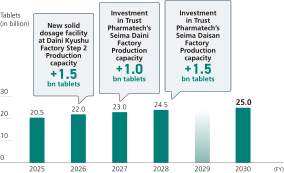
- Note:Assumptions for production capacity: For the current number of items, it is assumed that the machines are kept running in two shifts per day on weekdays. The number of items produced under contract manufacturing is not included.
We are systematically introducing robotics and automation and improving production efficiency. We are introducing the Laboratory Information Management System (LIMS), which supports laboratory testing, at all factories to further improve the efficiency of testing and quality control. We also view AI as a tool that can significantly improve how we use data on deviations and problems at factories and share knowledge. The Quality Event Management System launched last year stores cases from each factory as digital information. Using AI to rapidly search for and analyze similar past cases and responses should enable us to use this information as training material and improve the accuracy of investigations and decisions when problems occur.
One area we intend to pursue further is lifecycle management for individual products. When launching a new product, we use a range of indicators to assess the value it will deliver to society and its viability as a business, carefully determining whether it can be supplied sustainably. Medicines carry an extremely high level of social responsibility. If patients need a product and we are its sole supplier, we must take responsibility for continuing to deliver it to them.
At the same time, fulfilling our responsibility to ensure stable supply requires us to remain sustainable as a company. Through proactive investment in growth areas and appropriate earnings from other product groups, we must achieve a high-level balance between contributing to healthcare and maintaining a robust management foundation. Going forward, we will carefully assess the value of each product and maximize its role while further strengthening our stable supply system as social infrastructure.
We aim to remain a trusted company by translating each employee’s growth into organizational growth.
The top priority for management going forward is to strengthen our system for the stable delivery of medicines of reliable quality. We also intend to focus closely on providing the information needed for the proper use of medicines. Medicines can fully deliver their value only when correct information is provided on matters such as administration, handling, and interactions with other drugs. Our Medical Communications Department, medical representatives, and Medical Information Department work in close coordination to provide healthcare institutions and patients with the information they need.
I tell employees that I want them to recognize their role as professionals in “creating” medicines. Here, “creating” encompasses not only manufacturing but every process involved in delivering medicines to patients, from research and development to quality control and information provision. When each employee considers what they must do as a professional and continues to grow, this drives the growth of the entire organization. By promoting individual growth and close collaboration across organizations, we will enable our quality assurance systems to function at a higher level and achieve the stable supply of medicines of reliable quality.
By steadily building on and continuing these initiatives, we aim to remain the company of choice for patients and healthcare professionals and to earn the lasting trust of society at large. We will also enhance corporate value and contribute to healthy lives for all our stakeholders.
- Toshiomi Nakate
Director, Senior Managing Executive Officer
Representative Director and President of Sawai Pharmaceutical Co., Ltd. 
Related webpages
- Introducing the Sawai Group Holdings
- Management message

Download all pages
Download in sections
Download separate volume of Financial section
Back issues
- Year Ended March 31, 2025
- Year Ended March 31, 2024
- Year Ended March 31, 2023
- Year Ended March 31, 2022
- Year Ended March 31, 2021
- Year Ended March 31, 2020
- Year Ended March 31, 2019
- Year Ended March 31, 2018
- Year Ended March 31, 2017
- Year Ended March 31, 2016
- Year Ended March 31, 2015
- Year Ended March 31, 2014
- Year Ended March 31, 2013
- Year Ended March 31, 2012
- Year Ended March 31, 2011
- Year Ended March 31, 2010
- Year Ended March 31, 2009
- Year Ended March 31, 2008
- Year Ended March 31, 2007
- Year Ended March 31, 2006
- Year Ended March 31, 2005
- Year Ended March 31, 2004
- Year Ended March 31, 2003
- Year Ended March 31, 2002
- Year Ended March 31, 2001
- Year Ended March 31, 2000