

Ensuring a stable supply system
Roundtable discussion with the Head of Manufacturing Division and Factory Managers
Reliably delivering assured quality
Three production leaders discuss their mission and challenges
The Sawai Group is working to resolve the supply shortages affecting the generic drug industry as a whole. In this section, factory managers and the executive responsible for production discussed the progress made and the challenges ahead.
-
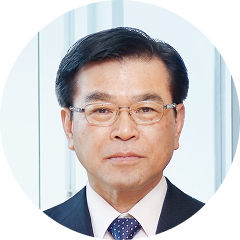
- Senior Executive Officer,
Group Chief Production Officer (Group CPO),
Sawai Group Holdings Co., Ltd. - Toshiya Hasuo
- Senior Executive Officer,
-
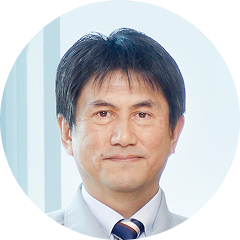
- Factory Manager
Daini Kyushu Factory
Sawai Pharmaceutical Co., Ltd. - Teruo Araki
- Factory Manager
-
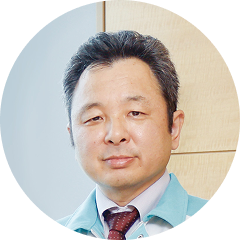
- Factory Manager
Trust Pharmatech Co., Ltd. - Toshihiro Yanagi
- Factory Manager
The Manufacturing Division’s Operating Environment and Our Roles
-
- Hasuo
- Supply shortages arose for numerous generic drug products following manufacturing and quality control issues at several generic drug manufacturers that came to light from 2020 onward. Sawai Pharmaceutical and other companies have been working to increase production, but the shortages have yet to be completely resolved. As the executive responsible for overseeing the Group’s Manufacturing Division, I am working to eliminate uncertainty surrounding the supply of generic drugs.
-
- Yanagi
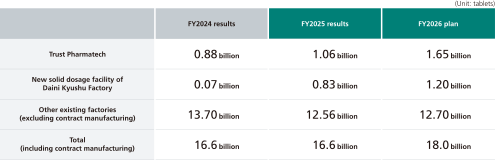
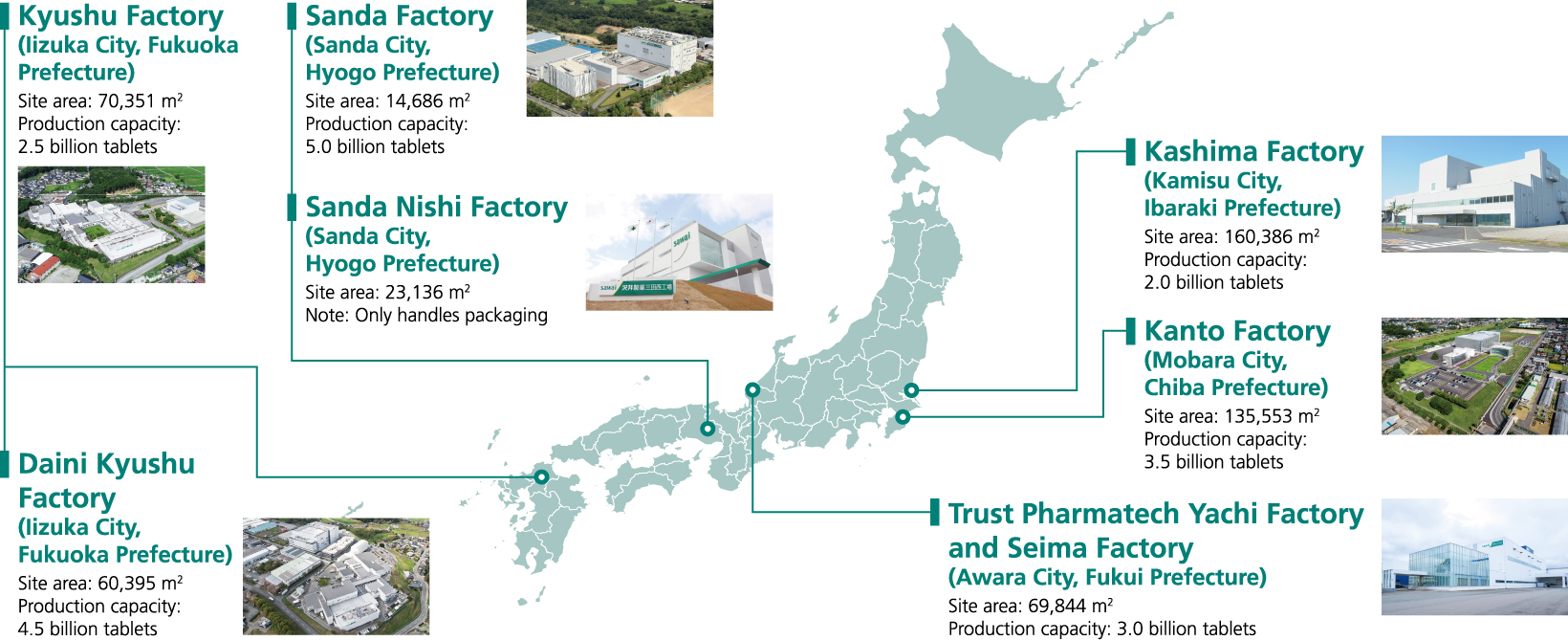
- As Factory Manager at Trust Pharmatech, I see my mission as contributing to a stable supply and expanded production capacity across the Group. Production volume was just over 1 billion tablets in fiscal 2025 and is expected to reach around 1.5 times that level, or 1.65 billion tablets, in fiscal 2026. Our factory production capacity is approximately 3 billion tablets, and installation of new equipment will be completed at Seima Factory No. 2 and Seima Factory No. 3 in 2027, leaving ample scope to increase production. Looking ahead, we will continue accepting products transferred from Sawai Pharmaceutical and supporting the expansion of the Group’s supply capacity.
-
- Araki
- At Sawai Pharmaceutical’s Daini Kyushu Factory, where I serve as Factory Manager, we are expanding production capacity in line with the Company’s policy of increasing the Group’s annual production capacity to 25 billion tablets by fiscal 2030. A new building was completed at the Daini Kyushu Factory in July 2024. In the first phase, equipment with production capacity of 2 billion tablets was installed, and shipments began in December of that year. As further production expansion is required, we are now installing additional equipment with capacity of 1.5 billion tablets as the second phase. I see my role as securing and developing the talent needed to accommodate increased production and establishing systems that strengthen quality assurance, in preparation for all equipment becoming operational as scheduled in December 2026.
-
- Hasuo
- Once the second phase of capital investment at the Daini Kyushu Factory is complete, the factory will have total production capacity of 6.0 billion tablets, including 2.5 billion tablets at the existing building. This will give it the Group’s largest production capacity for solid dosage forms, a major product category for Sawai Pharmaceutical. In terms of quality, the new building is equipped with a Manufacturing Execution System (MES) and Laboratory Information Management System (LIMS), establishing a framework that enables manufacturing and quality testing to be performed more easily and reliably.
Investing in people to support stable supply
-
- Yanagi
- Trust Pharmatech was established with 403 employees, including 243 production staff, transferred (along with facilities) from the former Kobayashi Kako. At the time of launch, we provided thorough GMP training and devoted considerable time to preparing operating procedures. We also dispatched more than 130 employees to Sawai Pharmaceutical factories, where they spent up to three years learning the standards established by the Group. Those employees have now returned to their respective workplaces and are taking the lead in sharing what they learned. I also feel that employees at production sites are increasingly drawing on their experience to determine what they need to do and act autonomously.
In July 2023, one year and three months after the company was established, we made our first shipment of a product manufactured through an integrated process from weighing to packaging. Former Kobayashi Kako employees were deeply emotional when they realized they could ship products from their factory again.
-
- Hasuo
- Trust Pharmatech invested considerable time and effort in production preparations. After receiving technology transfers from Sawai Pharmaceutical, it rebuilt all manufacturing and testing documentation in accordance with Group standards, thereby establishing a robust production system. When the new solid dosage facility at the Daini Kyushu Factory was being constructed, rapidly rising demand created expectations that production would begin earlier and ramp up faster than initially planned. Under this pressure, approximately 40 project members worked hard on everything from construction and equipment installation to preparations for launch, overcoming schedule extensions caused by extreme heat and heavy rain as well as rising prices. In parallel, they prepared the documentation needed to manufacture and test products using the new equipment and systematically recruited and trained the employees who would handle actual production. Securing and developing talent is the highest-priority issue for both factories. I am grateful that past talent development efforts have enabled steady progress in this way.
-
- Yanagi
- Our immediate challenge is developing mid-level personnel involved in manufacturing. We are applying Sawai Pharmaceutical’s training programs at Trust Pharmatech and are also introducing a mentoring system. Cultivating talent inevitably takes time. It is important to instill an awareness of compliance, maintain and improve each employee’s motivation, and further strengthen their sense of responsibility for handling pharmaceuticals that affect patients’ health.
-
- Araki
- At the Daini Kyushu Factory, recruitment has progressed smoothly since 2020, ahead of construction of the new building, with the cooperation of Iizuka City in Fukuoka Prefecture, where the factory is located. However, we face the same talent development challenge as Trust Pharmatech. From a quality assurance perspective, we must rapidly provide training that raises individual awareness and practical capabilities and revise operating procedures to meet increasingly stringent GMP requirements. We will continue using e-learning and other tools while focusing on training employees to obtain operator certification. I believe that expanding our training framework from a long-term perspective will enhance instructors’ teaching capabilities and accelerate the development of new employees.
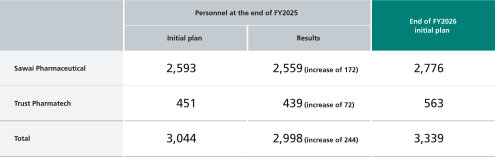
- Figures in parentheses show changes from the end of the previous fiscal year. Personnel figures are for factories only and include contract and temporary employees.
Fostering a Quality Culture
-
- Araki
- The Manufacturing Execution System (MES) and Laboratory Information Management System (LIMS) introduced at the Daini Kyushu Factory’s new building play a major role in reducing human error and dramatically improving the precision of quality control and assurance. They also improve production efficiency, for example by enabling one person, with support from the systems, to perform checks that previously required two people. When the systems were first introduced, some employees at the production site expressed concerns about the time required for implementation, a shortage of personnel capable of operating them, and a decline in work efficiency until employees became accustomed to them. However, by carefully explaining the benefits, including improved work efficiency and stronger quality assurance, we gained their understanding. The systems are now operating smoothly.
-
- Hasuo
- The number of Group employees has grown rapidly, more than doubling over ten years from 1,490 in March 2016 to 3,630 in March 2026. Of these, approximately one-quarter joined within the past two or three years. The development of mid-level personnel capable of leading production sites has not yet kept pace with this rapid organizational expansion. As highly proficient mid-level personnel are essential to ensuring quality, I have held repeated discussions on skills enhancement and talent development measures with Mr. Araki, Mr. Yanagi, and the other factory managers.
-
- Yanagi
- At Trust Pharmatech, many of our employees have experienced manufacturing control issues faced by the former Kobayashi Kako, so I feel that the importance of compliance as the foundation supporting the business is deeply rooted in each employee’s awareness. At the same time, we must remain alert to the risk that this awareness may fade as the number of mid-career hires increases and time passes. Training that merely presents technical terms will not communicate the message effectively. We therefore do not assume that participants already understand the material, but focus on presenting it in a way that they can accept and view as personally relevant. For example, we use videos to make the content easier to understand and provide training that enhances the skills of all employees, including new hires.
-
- Araki
- As Factory Manager, my foremost priority is operating the factory with safety first. On that basis, I emphasize maintaining a balance between ensuring quality and stable supply, while creating an open workplace environment that supports both.
-
- Hasuo
- Ensuring quality and stable supply are the two essential pillars of pharmaceutical manufacturing. However, quality issues often arise when this balance is lost and stable supply is given undue priority. Preventing problems requires active communication with supervisors and colleagues and an environment in which employees can speak candidly about difficulties or anything that does not seem right.
-
- Araki
- To improve the workplace environment and operations, including quality, the Group has long conducted M1 Club Activities. “M1” means “everyone striving to be number one.” Small groups spend approximately six months planning and carrying out improvement activities, then present the ideas they devised and the results achieved across the Company. Following Group-wide selection, the Daini Kyushu Factory won awards for two consecutive years in fiscal 2025 and fiscal 2026. From what I see at the production site, I feel that we are establishing a culture in which employees are conscious not only of safety and quality, but also identify issues themselves, exchange opinions candidly, and translate them into improvements.
-
- Yanagi
- Trust Pharmatech’s training programs also include active cross-departmental group discussions. Building internal relationships through training helps daily operations run more smoothly, so I tell participants to broaden their connections across departments to help create a more facilitative workplace. I have also built connections across departments through various opportunities over the years. The colleagues I met remain people I can rely on in difficult times. I believe this mutual support gives employees a sense that they are helping their colleagues and the company and contributing to society, ultimately fostering pride in never compromising on quality.
-
- Hasuo
- Streamlining and optimizing operations while putting quality first is another important challenge for the Manufacturing Division. In response to the quality testing issue that resulted in administrative sanctions, the Group has spent the past several years reviewing and rebuilding its quality control framework, including compliance with GMP. At the same time, the increase in required checks and other factors has temporarily reduced productivity per employee. Our next major task is to improve productivity without compromising quality by combining various measures, including process automation, longer periods of unattended operation, systemization, and the use of AI. At the beginning of fiscal 2025, we also established an improvement proposal program and a framework for sharing improvements among factories to promote continuous improvement activities. I see these efforts as more than simply establishing programs and systems. They are intended to foster a corporate climate and culture rooted in each employee’s awareness and actions. We will continue working steadily to foster a quality culture in which everyone embodies the Group’s desire to “push ourselves to pursue higher quality in everything we do” as stated in our Code of Conduct.
Building a Manufacturing Division growing with mutual employee inspiration in pursuit of higher quality
-
- Hasuo
- Guided by Sawai Pharmaceutical’s corporate philosophy of “always putting patients first” and our Group’s effort to “push ourselves to pursue higher quality in everything we do” as stated in our Code of Conduct, each factory is taking action toward four goals: become a team of highly committed employees; create a workplace with good communication; create a safe and secure workplace; and become a team of employees committed to talent development and personal growth. It is important to achieve all four of these in a balanced manner.
-
- Yanagi
- People are the key to these initiatives. The more equipment we add, the more it can produce, but the same does not apply to people. Employees need training to become fully proficient, and their development takes time. At present, that training cannot be replaced by AI, nor can the issue be resolved simply by adding more people. That is why I believe our mission is to carefully develop the talent who will pursue stable supply and quality as two equally important priorities.
-
- Araki
- As you say, it is important to maintain a balance among quality, stable supply, and talent development. Just as prioritizing stable supply alone can lead to quality being neglected, focusing too heavily on any one of these three will inevitably create distortions. As those ultimately responsible for our factories, we must continually assess this balance and steer operations accordingly. By doing so, we will fulfill our fundamental role of reliably delivering medicines of assured quality to society.
-
- Hasuo
- I regularly tell factory managers and department heads such as yourselves that we must continue learning and improving ourselves if we are to lead our subordinates effectively. By communicating these messages repeatedly and passionately, I want to make continuous self-improvement part of the Manufacturing Division’s culture and build a division whose members inspire one another and continue to grow.
Related webpages
- Introducing the Sawai Group Holdings
- Management message

Download all pages
Download in sections
Download separate volume of Financial section
Back issues
- Year Ended March 31, 2025
- Year Ended March 31, 2024
- Year Ended March 31, 2023
- Year Ended March 31, 2022
- Year Ended March 31, 2021
- Year Ended March 31, 2020
- Year Ended March 31, 2019
- Year Ended March 31, 2018
- Year Ended March 31, 2017
- Year Ended March 31, 2016
- Year Ended March 31, 2015
- Year Ended March 31, 2014
- Year Ended March 31, 2013
- Year Ended March 31, 2012
- Year Ended March 31, 2011
- Year Ended March 31, 2010
- Year Ended March 31, 2009
- Year Ended March 31, 2008
- Year Ended March 31, 2007
- Year Ended March 31, 2006
- Year Ended March 31, 2005
- Year Ended March 31, 2004
- Year Ended March 31, 2003
- Year Ended March 31, 2002
- Year Ended March 31, 2001
- Year Ended March 31, 2000