

Generic drug market landscape
Toward an era where Sawai is preferred for its quality and supply capabilities
The introduction of the Generic Drug Provider Evaluation System focused on quality and supply capabilities is expected to accelerate consolidation in the generic drug industry, a crowded field of approximately 190 companies.
The Sawai Group views this change as an opportunity and aims for sustainable growth through one of the industry’s largest-scale supply systems.
1 Current
situation An industry structure in which multiple companies market products containing the same active ingredient
Supported by government measures to promote their use under the 2004 Basic Policy on Economic and Fiscal Management and Reform, generic drugs in Japan increased their volume share from just over 16% in 2004 to approximately 90% in 2025, becoming essential infrastructure underpinning the nation’s healthcare system. However, ongoing reductions in NHI drug prices have kept the market virtually flat on a value basis over the past five years, putting pressure on the profitability of generic drug manufacturers.
The industry’s rapid growth has also led to an accumulation of structural challenges. Low barriers to entry have resulted in a fragmented market of approximately 190 companies. Even though we are one of Japan’s largest generic drug manufacturers, the Sawai Group held only around 16% of the generic drug market in 2025, according to our estimates.
Amid intense competition, manufacturers repeatedly launched new products as a survival strategy, making high-mix, low-volume production the norm and leading to lower production efficiency and weaker quality control systems.
Against this backdrop of structural challenges, manufacturing and quality control violations have been uncovered at several companies since 2020, and supply disruptions resulting from government orders to suspend operations have become more widespread. Compounded by supply chain disruption caused by the COVID-19 pandemic, concerns over drug supply have grown more serious and prolonged. As of September 2025, 14% of all drugs, or 2,224 products, were still subject to limited shipment or supply suspension, continuing to affect medical institutions.
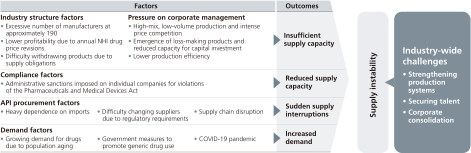
- Reference:Japan Generic Medicines Association, Report of the Study Group on Ideal Industrial Structure for a Stable Supply of Generic Drugs
https://www.jga.gr.jp/assets/uploads/2026/2683ec6909b711c72406e774af863408a37d936c.pdf
2 Drivers of
change Introduction of the government’s Generic Drug Provider Evaluation System
In response to these challenges, the government has recently embarked in earnest on reforming the industry’s structure. A report issued in May 2024 by the Study Group on Ideal Industrial Structure for a Stable Supply of Generic Drugs, etc. designated the next five years or so as an intensive reform period and set out three objectives: ensuring appropriate manufacturing and quality control systems, securing stable supply capabilities, and establishing a sustainable industry structure.
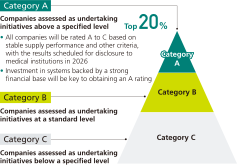
The Generic Drug Provider Evaluation System is central to these reforms. It assesses generic drug manufacturers against 17 indicators in four areas: disclosure of stable supply information, contingency capacity, supply performance, and deviation between NHI drug prices and actual selling prices. Manufacturers are classified into three categories: the top 20% as Category A, those scoring below zero points as Category C, and all others as Category B.
The key feature of this system is that evaluation results are directly linked to the NHI drug pricing system. Relatively high NHI drug prices are maintained for products supplied by Category A companies, while Category C companies receive no preferential pricing treatment. Moreover, disclosure of company names and evaluation categories to medical institutions is expected to encourage medical institutions and pharmacies to prioritize products from Category A companies. This represents a shift to a system that rewards companies contributing to stable supply through both NHI drug prices and market selection, and could fundamentally transform an industry structure previously centered on price competition.
In addition, the 2025 amendments to the Pharmaceuticals and Medical Devices Act introduced legal requirements to report supply suspensions and appoint managers responsible for stable supply systems. The government also established the Fund for Generic Drug Manufacturing Infrastructure Development, totaling ¥84.4 billion, to support product consolidation and capital investment, thereby addressing high-mix, low-volume production through both institutional and financial measures.
3 Future
outlook Consolidation around highly reliable companies
Through these reforms, the generic drug industry is expected to consolidate around companies with strong quality control and stable supply systems. According to estimates by the Japan Generic Medicines Association, industry-wide supply and demand will be nearly balanced in fiscal 2026, while supply is projected to exceed demand by approximately 4% in fiscal 2029, the final year of the intensive reform period. Product consolidation and intercompany collaboration are also beginning to take concrete shape, and steady progress is being made in addressing high-mix, low-volume production.
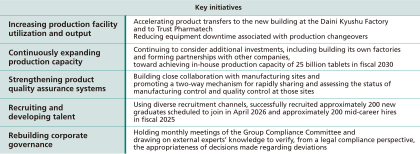
The Sawai Group views these changes in the business environment as a growth opportunity. To enhance its quality management systems, the Group has assigned on-site QA personnel* reporting directly to the pharmaceutical manufacturing supervisor at its factories. It is also diversifying its API suppliers and taking all necessary steps to achieve a Category A rating under the Generic Drug Provider Evaluation System.
The Group is also expanding production capacity, including through construction of a new building at the Daini Kyushu Factory, and expects to have an industry-leading annual production capacity of 25 billion tablets by the end of fiscal 2030. Since fiscal 2023, it has also shifted to a sales strategy emphasizing appropriate pricing, seeking to achieve both stable supply and profitability.
- *On-site personnel verify that GMP activities at factories are conducted in accordance with prescribed procedures, among other matters.
Related webpages
- Introducing the Sawai Group Holdings
- Management message

Download all pages
Download in sections
Download separate volume of Financial section
Back issues
- Year Ended March 31, 2025
- Year Ended March 31, 2024
- Year Ended March 31, 2023
- Year Ended March 31, 2022
- Year Ended March 31, 2021
- Year Ended March 31, 2020
- Year Ended March 31, 2019
- Year Ended March 31, 2018
- Year Ended March 31, 2017
- Year Ended March 31, 2016
- Year Ended March 31, 2015
- Year Ended March 31, 2014
- Year Ended March 31, 2013
- Year Ended March 31, 2012
- Year Ended March 31, 2011
- Year Ended March 31, 2010
- Year Ended March 31, 2009
- Year Ended March 31, 2008
- Year Ended March 31, 2007
- Year Ended March 31, 2006
- Year Ended March 31, 2005
- Year Ended March 31, 2004
- Year Ended March 31, 2003
- Year Ended March 31, 2002
- Year Ended March 31, 2001
- Year Ended March 31, 2000