

GovernanceBoard of Directors
Skills Matrix
We have identified seven specific skills required for the Board of Directors based on our corporate philosophy and sustainability key policy, considering our relationships with stakeholders and material issues. We ensure that these skills are balanced across the directors. This policy has been approved by the Nomination, Remuneration and Other Governance Committee.
| Name | Sex | Outside Director | Nationality | Expertise and experience | ||||||
|---|---|---|---|---|---|---|---|---|---|---|
| Corporate management | Healthcare | Global | Medical and Pharmaceutical Sciences | Finance, Accounting, and Taxation | Legal and Risk Management | Sustainability / ESG | ||||
| Other than Audit & Supervisory Committee Members | ||||||||||
| Mitsuo Sawai | Male | Japan | ○ | ○ | ||||||
| Toshiomi Nakate | Male | Japan | ○ | ○ | ○ | ○ | ||||
| Taku Nakaoka | Male | Japan | ○ | ○ | ○ | ○ | ○ | |||
| Masatoshi Ohara | Male | ◆ | Japan | ○ | ○ | ○ | ||||
| Masayuki Mitsuka | Male | ◆ | Japan | ○ | ○ | ○ | ○ | |||
| Yasuko Aitoku | Female | ◆ | Japan | ○ | ○ | ○ | ○ | |||
| Audit & Supervisory Committee Member | ||||||||||
| Tadao Tsubokura | Male | Japan | ○ | ○ | ||||||
| Etsuko Taniguchi | Female | ◆ | Japan | ○ | ○ | |||||
| Yukiyo Nose | Female | ◆ | U.S. | ○ | ○ | ○ | ○ | ○ | ○ | |
Reasons why we consider it important.
| Corporate management | Experience in decision-making based on the corporate philosophy and assuming management responsibility is essential for management decisions that lead to the sustainable growth of the Group. |
|---|---|
| Healthcare | Broad knowledge and experience in healthcare fields are important for expanding our core business, including new businesses as well as pharmaceuticals, and for enhancing corporate value. |
| Global | A deep understanding of global markets and regulations is important for business operations, including international supply chains. |
| Medical and Pharmaceutical Sciences | As a comprehensive healthcare company, expertise in medical and pharmaceutical sciences is crucial for creating value in overall management, including quality improvement, by identifying the needs of healthcare professionals and patients. |
| Finance, Accounting, and Taxation | Sound knowledge in finance, accounting and taxation is important to accurately assess company value, improve capital efficiency and ensure proper tax payments. |
| Legal and Risk Management | Strong legal and risk management capabilities are essential to identify and judge rules and assess risks in order to maximize corporate value through optimal decision-making. |
| Sustainability / ESG | ESG perspectives are indispensable for both the Group's sustainable growth and its ability to address social issues. |
Improving the operation of the Board of Directors
The Board of Directors deliberates important matters at the Group Investment Committee and the Group Strategy Council before referring them to the Board of Directors, in order to ensure that in-depth discussions focus on the most important points. In addition, based on “the Regulations on Affiliated Company Management”, the Board of Directors is informed of the important management status of Group companies, and delegates authority to Group companies to make decisions on matters within certain criteria, thereby achieving a balance between supervision of Group companies and speedy decision-making.
Corporate Officer Remuneration System
Remuneration plan for Directors (excluding Directors who are members of the Audit & Supervisory Committee and Outside Directors) consists of a base remuneration (fixed), bonuses (performance-based), and restricted stock remuneration as a medium- to long-term incentive.
Restricted stock remuneration consists of two types:
- Service-continuation-type restricted stock awards, which are granted in advance in accordance with predetermined rules based on position and other factors.
- Performance-based restricted stock awards, which are granted retrospectively based on the achievement of the Company’s medium- to long-term corporate value enhancement targets.
Restricted stock remuneration is granted based on position, years of service and performance, in accordance with separately established internal regulations, with the aim of granting at least 10% of the total remuneration amount.
The ratio of basic remuneration to performance-linked remuneration shall be approximately 3:1.
The maximum amount of remuneration for directors (excluding directors who are members of the Audit & Supervisory Committee) is set at 620 million yen per year (of which one hundred million yen is for outside directors).
This was decided by the Board of Directors after deliberations and reports by the Company's Nomination, Remuneration and Other Governance Committee, and was then resolved at the 5th Annual General Meeting of Shareholders on 25 June 2026.
The specific amount and timing of payment to each director (excluding outside directors and directors who are members of the Audit Committee) will be determined by resolution of the Board of Directors after deliberation and report by the Nomination, Remuneration and other Governance Committee. The amount of remuneration for directors does not include the employee portion of salaries for directors who are also employees.
The Company has a policy for determining the content of remuneration for individual directors, and this is in line with that policy.
The total amount of monetary remuneration claims paid as continuing service-type restricted stock awards is set at up to fifty million yen per year, and the total amount of monetary remuneration claims paid as performance-based-type restricted stock units is set at up to one hundred million yen per year.
In addition, the maximum amount of remuneration for directors who are members of the Audit & Supervisory Committee is set at up to one hundred million yen per year. The specific amounts and timing of payments for each member of the Audit & Supervisory Committee will be determined through consultation among the members of the Audit & Supervisory Committee.
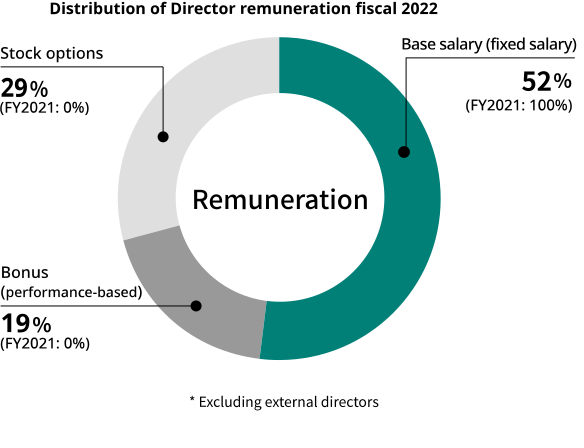
Distribution of remuneration for Directors and Audit & Supervisory Board Members (A & SB Members)
| Classification | Total remuneration (Millions of yen) |
Total remuneration by category (Millions of yen) |
Number of eligible persons |
|||
|---|---|---|---|---|---|---|
| Fixed salary | Performance-linked remuneration |
Restricted stock remuneration | ||||
| Service-continuation-type | Performance-based | |||||
| Directors (not including the Audit & Supervisory Committee Members and Outside Directors) |
97 | 62 | 22 | 6 | 7 | 2 |
| Directors (Audit & Supervisory Committee Members) (not including Outside Directors) |
14 | 14 | - | - | - | 1 |
| A & SB Members (not including Outside A & SB Members) |
5 | 5 | - | - | - | 1 |
| Outside Directors and A & SB Members | 48 | 48 | - | - | - | 8 |
Training policy for Directors and Audit & Supervisory Board members
We will proactively provide directors and Audit & Supervisory Committee members with a wide range of information, including updates on the Company’s business operations and financial status, to enable them to effectively fulfill their roles and responsibilities. In addition, we will offer information on relevant industry systems and governance frameworks, as well as training opportunities and other resources, as necessary.
Support system for Outside Directors
Support system for Outside Directors (excluding directors who are members of the Audit & Supervisory Committee)
When outside directors (excluding those who are members of the Audit & Supervisory Committee) incur expenses such as investigation costs while performing their duties, we recognize their right to claim reimbursement for such expenses within reasonable limits. In addition, to enable outside directors (excluding directors who are members of the Audit & Supervisory Committee) to fully focus on their responsibilities, members of the Group General Affairs Department and the Group Sustainability Management Department provide administrative support, thereby facilitating information sharing and strengthening the supervisory functions of outside directors.
Support system for outside directors who are members of the Audit & Supervisory Committee
The full-time director serving as a member of the Audit & Supervisory Committee acts as a liaison among the Audit & Supervisory Committee, the Board of Directors, and the accounting auditor. This director also receives reports from relevant internal departments and communicates necessary information to those departments, thereby establishing a framework that enables outside directors who are members of the Audit & Supervisory Committee to efficiently fulfill their audit responsibilities. In addition, the full-time Audit & Supervisory Committee member consolidates opinions and reports from each outside director serving on the committee, prepares agenda items for committee meetings, and implements measures to ensure the smooth operation of the Audit & Supervisory Committee. Should outside directors who are members of the Audit & Supervisory Committee require expenses such as investigation costs for audit activities, we recognize their right to claim such expenses within reasonable limits. To further support these outside directors in focusing on their audit duties, members of the Group Internal Inspection Office provide administrative assistance, thereby facilitating information sharing and strengthening the supervisory and audit functions of outside directors who are members of the Audit & Supervisory Committee. In these cases, assistants operate independently from the direction, orders, and supervision of directors, and perform their duties under the supervision of either the outside directors (excluding Audit & Supervisory Committee members) or the outside directors who are members of the Audit & Supervisory Committee, as appropriate.
Others
The “Outside Directors’ Liaison Meeting,” consisting of outside directors and directors who are Audit & Supervisory Committee members, is generally held once a month to facilitate the exchange of opinions and information. Additionally, the Board of Directors Secretariat (Group Sustainability Management Department) distributes materials in advance to all Board members, including outside directors, and provides prior explanations as necessary to enhance the quality of discussions at Board meetings.
Independence Standards for Outside Directors / Audit & Supervisory Committee members
Reasons for Appointment of Outside directors
| Name | Designation as Independent director | Reasons of Appointment |
|---|---|---|
| Masatoshi OharaAttended Meetings (FY2025) Board of Directors: 14/14 (100%) |
Applicable |
Except for his service as an outside director of SAWAI PHARMACEUTICAL, Mr. Masatoshi Ohara is not, and has never been, an officer or employee of the Sawai Group, a major shareholder or investor, a major business partner, a consultant, an accounting expert or a legal expert who receives a large amount of money or other assets, nor is he from any of them, nor is he a close relative of any of them, and is not thought to pose a risk of conflict of interest. In addition, he has a wide range of legal knowledge through his activities as an attorney and has experience as an outside director of other companies. Therefore, we believe that he can be expected to provide useful advice and judgment from an independent standpoint, which will strengthen the supervisory function of the Board of Directors and improve transparency. In consideration of the above, he has been appointed as an outside director and Independent Officer. |
| Masayuki MitsukaAttended Meetings (FY2025) Board of Directors: 14/14 (100%) |
Applicable |
Mr. Masayuki Mitsuka is not, and has never been, an officer or employee of the Sawai Group, a major shareholder or investor, a major business partner, a consultant, an accounting expert or a legal expert who receives a large amount of money or other assets, nor is he from any of them, nor is he a close relative of any of them, and is not thought to pose a risk of conflict of interest. In addition, as a former top executive of a leading manufacturer and distributor of ethical pharmaceuticals in Japan, he has a wealth of expertise and experience. Therefore, we believe that he can be expected to provide useful advice and judgment from an independent standpoint, which will strengthen the supervisory function of the Board of Directors and improve its transparency. In consideration of the above, he has been appointed as an outside director and Independent Officer. |
| Yasuko AitokuAttended Meetings (FY2025) Board of Directors: 11/11 (100%) (elected June 2025) |
Applicable |
Ms. Yasuko Aitoku has never been, nor is she currently, an officer or employee of the Sawai Group, a major shareholder or investor, a major business partner, a consultant, an accounting expert, or a legal expert who receives a large amount of money or other assets, nor is she from any of them, nor is she a close relative of any of them, and is not thought to pose a risk of conflict of interest. She has extensive expertise in medicine and pharmacology, along with experience in the corporate management of pharmaceutical businesses. We believe her independent perspective will enable her to offer valuable advice and sound judgment, thereby enhancing the Board of Directors oversight function and improving overall transparency. Based on the above, she has been appointed as an outside director and Independent Officer. |
| Etsuko TaniguchiAttended Meetings (FY2025) Board of Directors: 11/11 (100%) (elected June 2025) |
Applicable |
Ms. Etsuko Taniguchi has never been, nor is she currently, an officer or employee of Sawai Group, a major shareholder or investor, a major business partner, a consultant, an accounting expert, or a legal expert who receives a large amount of money or other assets, nor is she from any of them, nor is she a close relative of any of them, and is not thought to pose a risk of conflict of interest. In addition, she has experience and extensive knowledge as an accounting and tax specialist, and is expected to provide valuable advice and objective, independent auditing of the Company’s management decisions and execution, thereby strengthening the Board’s supervisory function and improving transparency. While she has not been directly involved in corporate management beyond her roles as an outside director or auditor, we believe she is qualified to fulfill the responsibilities of an outside director based on the reasons outlined above. Based on the above, she has been appointed as an outside director and independent officer. |
| Yukiyo NoseAttended Meetings (FY2025) Board of Directors: 11/11 (100%) (elected June 2025) |
Applicable |
Ms. Yukiyo Nose (Japanese American) has never been, nor is she currently, an officer or employee of Sawai Group, a major shareholder or investor, a major business partner, a consultant, an accounting expert, or a legal expert who receives a large amount of money or other assets, nor is she from any of them, nor is she a close relative of any of them, and is not thought to pose a risk of conflict of interest. In addition, she has a wealth of knowledge gained from many years of experience in a wide range of fields, including corporate management, medical and pharmaceutical sciences, and ESG. She is expected to provide valuable advice and auditing from an independent and global perspective, thereby strengthening the Board’s supervisory function and enhancing transparency. Based on the above, she has been appointed as an outside director and independent director. |
Evaluation of the effectiveness of the Board of Directors
It is the Company’s policy to analyze and evaluate the effectiveness of the Board of Directors once a year and make improvements as necessary. Below is a summary of the results of the evaluation of the effectiveness of the Board of Directors in fiscal 2025.
Evaluation method
We adopted an anonymous self-evaluation method for all eight members of the Board of Directors (consisting of five Directors who are not Audit & Supervisory Committee Members [including three Outside Directors] and three Directors who are Audit & Supervisory Committee Members [including two Outside Directors]) based on a questionnaire survey prepared by an external organization.
Evaluation items
The evaluation consists of forty questions in total, combining a 5-point scale multiple-choice format with open-ended sections where respondents can freely share opinions on performance and areas for improvement. The evaluation covers the following thirteen themes:
- Composition of the Board of Directors
- Operation of the Board of Directors
- Management Strategy and Business Plans
- Internal Controls and Risk Management
- Nominations and Remuneration
- Performance of inside directors
- Performance of outside directors
- Support system for directors
- Dialogue with shareholders (investors)
- Directors’ own efforts
- Evaluation of the Nomination, Remuneration and Other Governance Committee
- Evaluation of the Audit & Supervisory Committee
- Summary
Primary Opinions Raised in the Evaluation
In the open-ended comments for each theme, the following opinions were primarily raised.
Human Resources Strategy, Nomination, Remuneration, etc.
- Diversity: Highly appreciate that the Nomination, Remuneration, and Other Governance Committee discusses the promotion of women, foreign nationals, and mid-career hires, and reports these matters to the Board.
- Succession: Continuous and in-depth discussions are being held regarding director succession plans and mandatory retirement rules.
- Labor Shortage: Expanding the business amid future labor shortages is a major management challenge, and further deliberation from this perspective is highly desired.
- Silo Breaking: Internal silos remain strong, resulting in insufficient cross-departmental utilization of talent. Inside directors are expected to take the initiative as management members to break through the status quo.
Board of Directors Operations
- Backgrounds: Highly appreciate that the diversification of backgrounds among outside directors has enabled multi-faceted deliberations.
- Efficiency: Continuous annual improvements are visible in efficient board operations, such as the early distribution of materials and prior information sharing through outside director meetings.
- Materials: Conversely, some materials are voluminous and overly detailed; their content should be better streamlined to serve the core purpose of the discussions.
- Perspective: Outside directors occasionally focus too heavily on technical details from their specialized perspectives; discussions from a broader, strategic standpoint are desired.
Management Strategy and Business Plan
- Capital Efficiency: Analyses and discussions regarding capital efficiency and other matters are conducted thoroughly. Constructive and candid opinions have increased, and progress aligned with management strategy is being verified through quarterly financial reviews.
- Growth Balance: On the other hand, further discussion and consensus-building are required regarding the balance with future growth investments.
- Profit Commitment: Improvements are also needed regarding the strong commitment to achieving target profit margins and the thorough preparation of contingency measures for unplanned costs.
Internal Controls, Risk Management, etc.
- Accountability: Appropriate management and accountability are being maintained, supported by the creation and implementation of risk scope definitions and monitoring manuals, as well as detailed updates on dialogues with overseas institutional investors.
- Monitoring: However, the Board should periodically review the adequacy of monitoring functions and ensure timely information sharing and comprehensive responses regarding the cross-organizational impacts of legal and regulatory changes.
Evaluation results
The overall average score across all forty questions was 4.0 out of 5.0 (an improvement of 0.1 points from the previous year). An overall upward trend was evident, with an increasing number of items exceeding peer averages, including areas previously identified as challenges.
In particular, notable improvements from the previous evaluation were observed in areas such as “succession planning,” “the number of board members,” and “follow-up on resolutions.” Based on these results, the Company has concluded that the Board of Directors is generally functioning effectively as a whole, although there remains room for partial improvement.
Challenges and directions for further improvement in effectiveness
To further enhance the effectiveness of future Board meetings, the Company will address the following improvement areas:
- Deepening discussions on management strategy from a broad, long-term perspective focused on growth, while maintaining strong awareness of profitability and capital efficiency.
- Facilitating appropriate discussions regarding diversity targets for core human resources, talent development policies, and internal environment enhancement strategies.
- Strengthening internal controls and risk management functions across the entire Group, and enriching deliberations on sustainability initiatives.
Policy and Process for Appointing Executive Officers, Candidates for Directors
The Board of Directors’ policy for appointing senior management responsible for the sustainable growth of our company and the enhancement of corporate value over the medium to long term, as well as for nominating candidates for the Board, is to fully respect the advice and recommendations of the Nomination, Remuneration and Other Governance Committee. The Board considers the overall size, balance, and diversity of the Board, and determines nominees based on a comprehensive assessment of their experience, expertise, business performance, insight, dignity, and other factors appropriate to the duties of the Board. The procedures for these decisions are stipulated in the “Regulations of the Board of Directors” and the “Regulations of the Nomination, Remuneration and Other Governance Committee.”
Executive officers are appointed by the Board of Directors after deliberation by the Nomination, Remuneration and Other Governance Committee, from among persons who have a record of consistent high performance in management positions, the experience and expertise required for the responsibilities of their positions, and the integrity of character and the high degree of insight and dignity appropriate for senior management positions.
The policy for nominating candidates for Directors who are members of the Audit & Supervisory Committee is determined in accordance with the “Code of Audit & Supervisory Committee Auditing and Supervising Standards” including ensuring independence from the executive management and maintaining a fair and unbiased attitude. The procedures for such nominations are set forth in the “Regulations of the Audit & Supervisory Committee.”
The policy for dismissing senior management, including directors, is also determined with full respect for the advice and recommendations of the Nomination, Remuneration and Other Governance Committee, and with comprehensive consideration of the following:
- When a member of management no longer meets the requirements for appointment
- In the event of violations of laws, regulations, the Articles of Incorporation, or other acts that damage the Company s credibility
- Inability to perform duties due to mental or physical incapacity or other health reasons
- In the event that he or she violates the duty of care of a good manager and causes significant loss to the Company.
These procedures are also stipulated in the relevant regulations.
Succession Planning for the CEO and other executives
The Nomination, Remuneration and other Governance Committee primarily deliberates on matters such as the appointment of senior management (including the CEO) and candidates for outside directors, CEO succession planning (including the appointment of representatives of core operating companies), and plans for developing future management talent. The outcomes are reported as recommendations to the Board of Directors, following broad, open, and vibrant discussions.
Policy for Cross-Shareholdings, and Voting Guideline
To achieve sustainable growth and enhance corporate value over the medium to long term, the Sawai Group may hold listed shares as deemed necessary as part of its management strategy, but, in principle, does not hold shares for the purpose of pure investment. We also view Cross-shareholdings as a potentially effective means of forming strategic alliances. When the Group holds listed stocks, the Board of Directors periodically reviews the rationale for major policy stock holdings, considering the purpose of holding, including the cost of capital. If the Board determines that a holding is not rational, it is the Group’s policy to reduce such holdings.
The Mid-Term Business Plan includes a policy to reduce Cross-shareholdings in line with the “Basic Policy on Reviewing Business Portfolio and Capital Policy,” which was approved by the Board of Directors in January 2024. During fiscal 2025, we partially sold one stock as part of a review of our cross-shareholdings, taking into account capital efficiency and liquidity.
When exercising voting rights, we do not apply uniform standards, as the content and background of each proposal differ. We exercise voting rights appropriately after considering whether each proposal contributes to the sustainable growth of the Group and the enhancement of corporate value over the medium to long term, deepening our understanding of the management policies and proposals of the relevant company through dialogue.